

Overview
One connected path from friction to progress.
Turn repetitive work into reliable, connected workflows so your Santa Barbara business can spend more time serving customers and making confident decisions.
The approach
Automate Your Business
Busy businesses rarely need more software for its own sake. They need the everyday handoffs—leads, follow-ups, updates, approvals, and reporting—to move without constant chasing. Phase 3 works with you to identify the repeatable work that deserves a better path, then designs practical automations around your existing operations and goals. The result is a clearer way to run the routine, with your team still in control of the important human moments.
How it works
Connect the useful pieces around a recognizable outcome.
Solutions coordinate strategy, implementation, measurement, and practical education so the work keeps helping after the immediate project is done.
A sensible sequence
Our process
Each step creates the clarity needed for the one after it—without adding work that does not serve the goal.
- 01Map the routine: identify the repeatable tasks, handoffs, and bottlenecks worth simplifying
- 02Choose the right path: define the workflow, tools, decision points, and human checks
- 03Build and connect: configure the automation and link the systems it needs
- 04Test, launch, and tune: review the workflow with your team and refine it as work evolves
General pricing
Use a range to plan. Use a quote to decide.
- Typical market range
- $15,000–$75,000+
- Common engagement
- multi-system automation initiative
These are broad U.S. small-business market reference ranges, not a Phase 3 quote, offer, or financing term. Scope, existing systems, content readiness, integrations, timelines, third-party platforms, advertising spend, taxes, and ongoing support can materially change the final investment.
Questions before the work begins
Clear scope makes a solution more useful.
Does this replace the individual services?
How do we decide where to begin?
Can the plan work with our existing systems?
Planning tools
Test the next move before you commit to it.
Use a website-profit scenario, work backward from a revenue goal, or compare the contribution of your inbound channels. Each tool starts with the assumptions you choose and gives you a clearer question to bring to the next conversation.
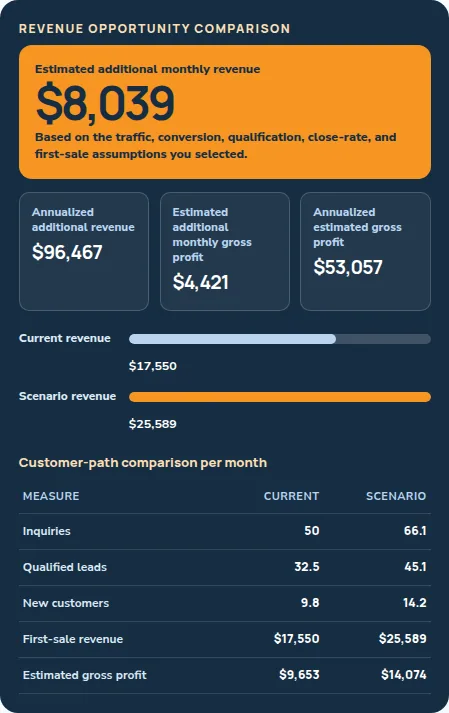
Website & marketing scenario
Website Profit Potential Calculator
Test how changes in traffic, inquiry quality, conversion, close rate, and first-sale value could affect first-sale revenue and estimated gross profit.
- A baseline from your website visitors, inquiries, qualification, closes, first sale, and margin
- The planning levers connected to traffic, conversion, qualification, close rate, and average first sale
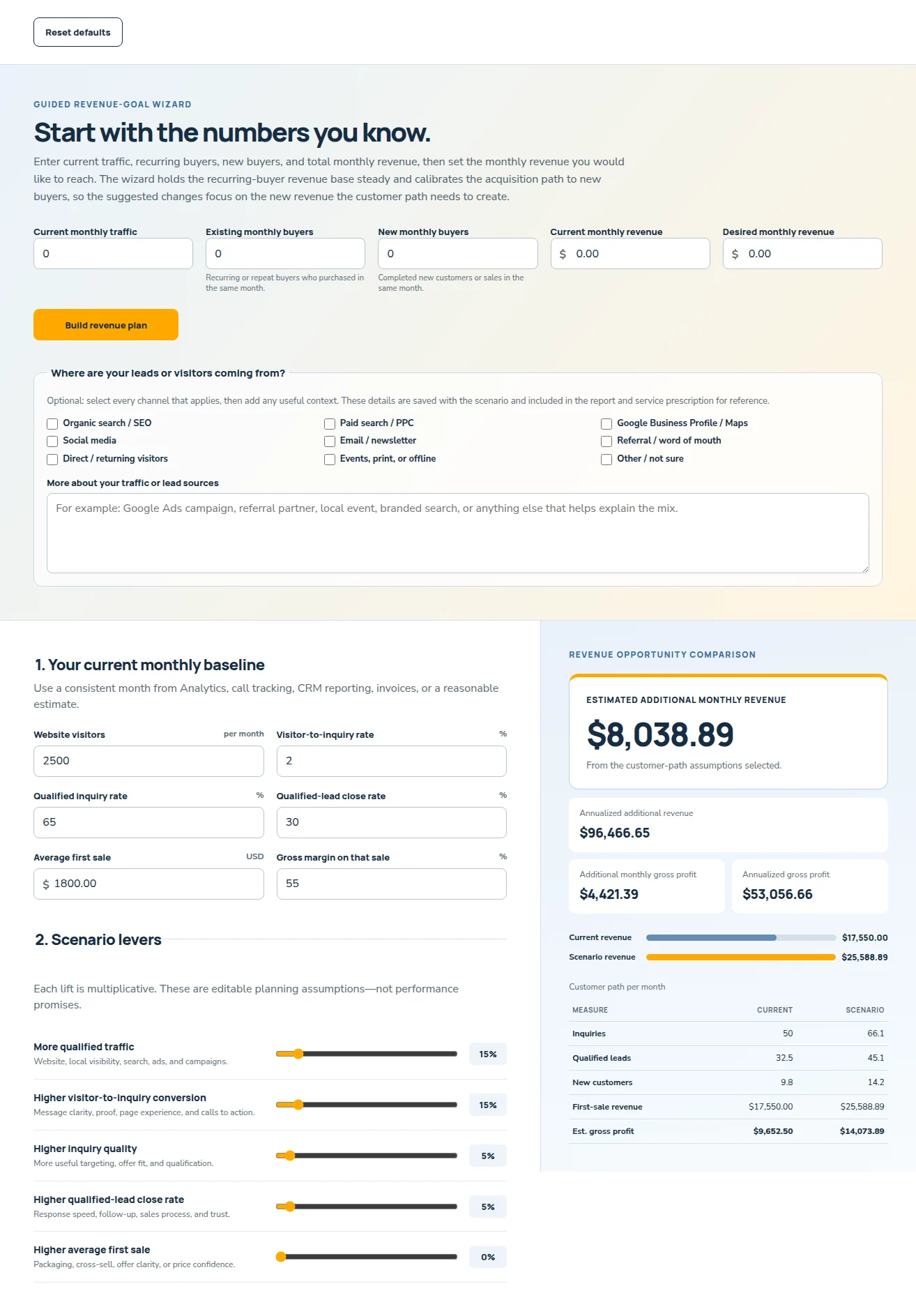
Revenue-goal scenario
Reverse Revenue Planner
Start with traffic, recurring and new monthly buyers, current revenue, and a revenue goal to map the customer-path changes that could be worth testing.
- Your current traffic, recurring buyers, new buyers, and total monthly revenue
- A desired monthly revenue target and the modeled customer-path changes behind it
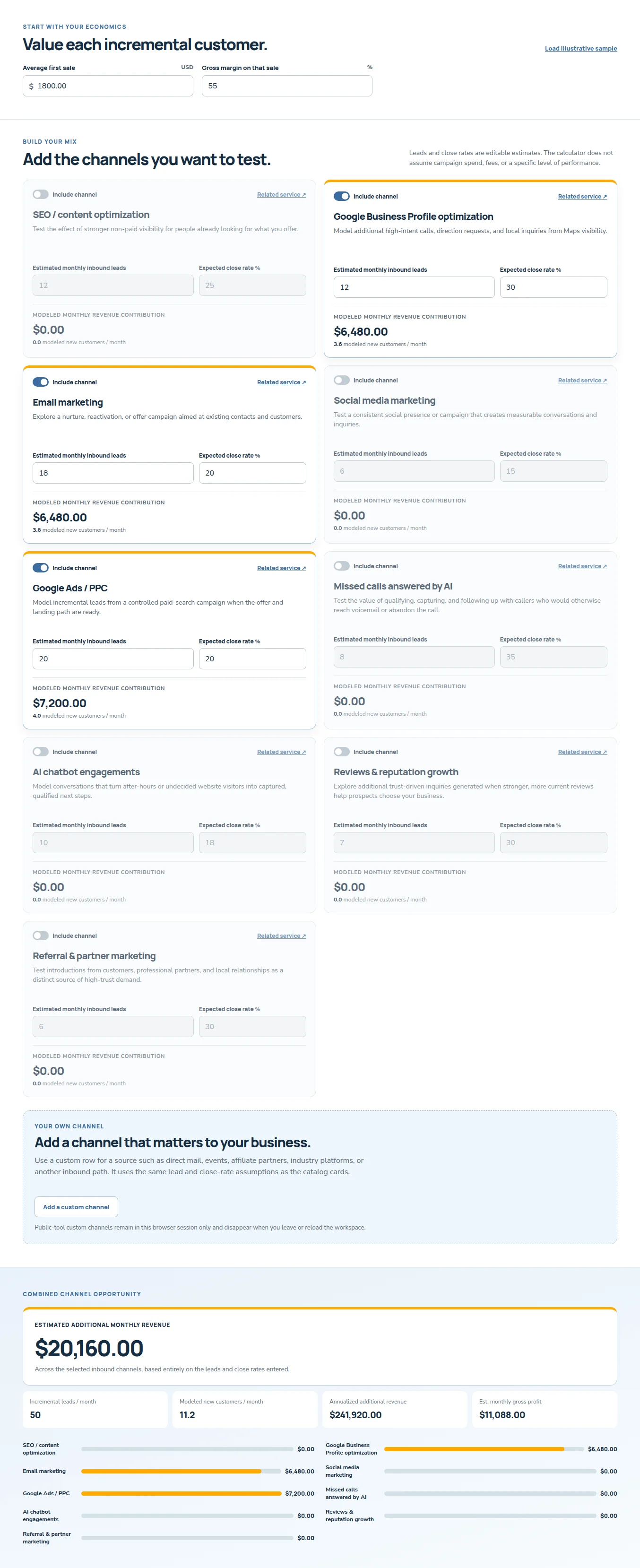
Marketing-mix scenario
Inbound Channel Impact Calculator
Compare a mix of search, local visibility, email, social, paid, AI-assisted, review, and referral channels using your own lead and close-rate assumptions.
- Ten inbound channels, including exit intent pop-ups & opt-ins, missed calls & DM's answered by AI, and AI chatbot engagements
- Expected inbound leads, close rate, average first sale, and gross margin for each selected channel
Planning notice. All calculator outputs are hypothetical projections; actual results will vary. Public workspaces start fresh and do not save scenarios, email reports, create prescriptions, or expose saved records.
Practical resources
Bring a more useful question to the next conversation.
Start with the checklist, then use the related learning below when it matches the decision in front of you.
Practical checklist
Operations Automation Checklist
Connect repetitive work into a reliable sequence while keeping people in control.
- Map the current trigger, handoffs, decisions, exceptions, and owner for the routine.
- Choose which steps can be automated and which require human review.
- Confirm system access, data quality, notification rules, and failure alerts.
7 points to work through
Get the checklistCourse
AI for Small Business: Start with the Workflow
A beginner-friendly path for finding useful AI opportunities and adding safe human review.
Get accessGuide
Common ChatGPT Mistakes
A useful checklist for avoiding unreliable output, vague prompts, and missed review steps.
Get accessThe checklist uses a short business-information form, then arrives by email and stays in your client portal. Related courses and guides use their own opt-in forms; the self-check quiz is available directly.
